
The essentials
Chew sticks offer a focused chewing option; a toy set lets you vary objects. Neither guarantees interest. Check materials, condition and dimensions, then supervise each introduction.
Start with your rabbit’s preferences
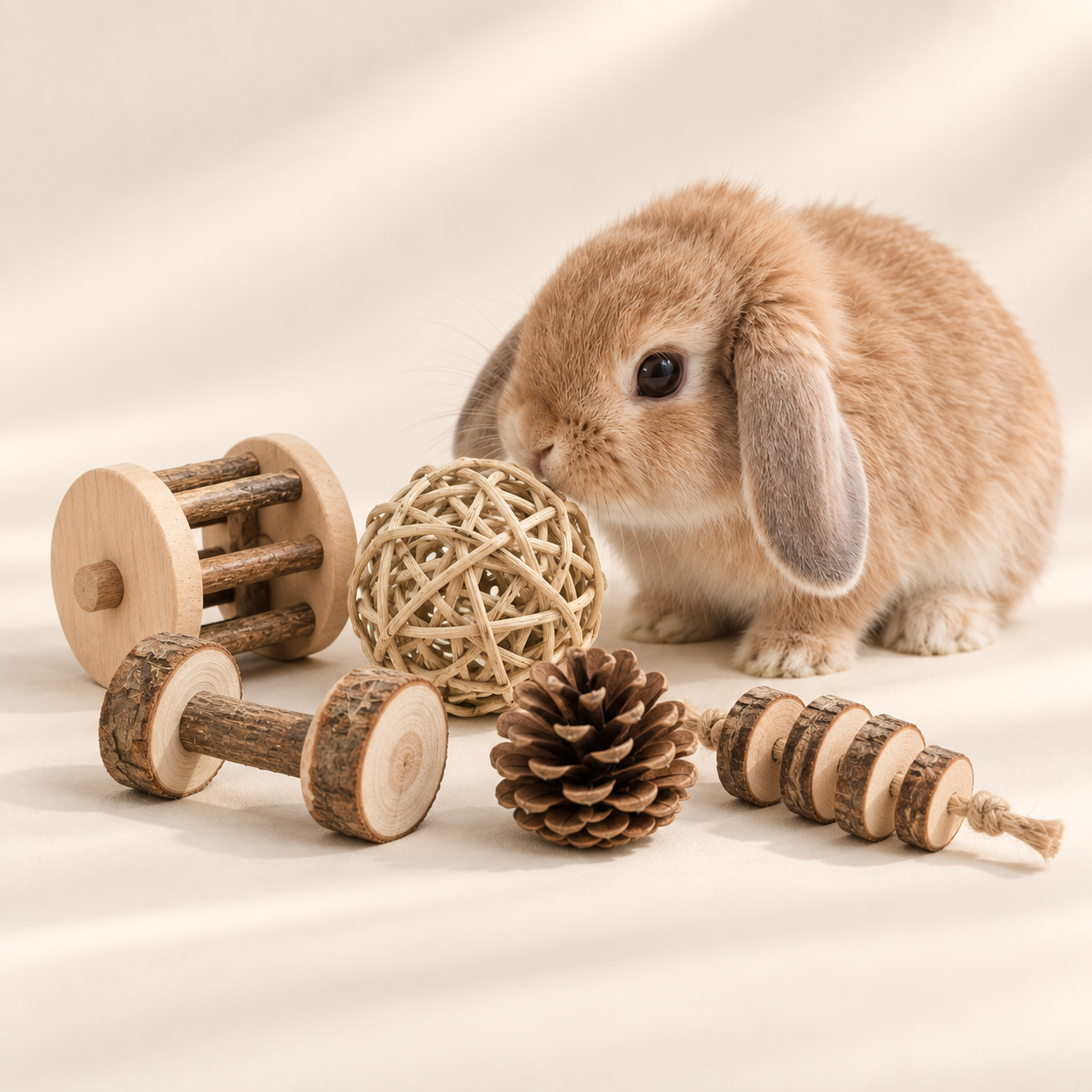
Choosing between wooden rabbit toys and chew sticks starts with observing the objects your bunny already knows. Some rabbits move a small item around; others investigate for a while before engaging. Note which activities are used, which are ignored and when your companion prefers to rest. Your first purchase can stay simple: one suitable item introduced in a familiar place, followed by observation. This guide compares two catalogue references without promising that any particular purchase will entertain every rabbit. Actual interest is more useful than a basket full of new objects. The choice should reflect your home and the rabbit living in it.
Two references and two starting points
Apple wood chew sticks are listed at €9.90. The five-piece natural wood toy set is listed at €14.90. Price alone does not settle the decision. Sticks offer one particular kind of object, while a set gives you several pieces to explore. Read the features of each reference before deciding how it might fit your setup. Ask for confirmation if detailed composition or dimensions are missing. Catalogue names provide a starting point rather than a universal suitability guarantee. Choosing just one reference and waiting to learn your rabbit’s preferences is entirely reasonable; there is no need to buy both immediately.
Understand what the article price covers
An article price helps compare budgets, but it does not tell you how much your rabbit will use or how long an accessory will last. Do not assume that a five-piece set will last five times longer than another product. Ask about exact contents where necessary and think about what you actually plan to offer. Both references together total €24.80 in products before shipping, without a discount. That is a basket example rather than a required bundle. Starting with one object may be more useful than buying several items before knowing which ones your bunny will use in everyday life.
Check materials beyond the word natural
Natural is not a substitute for checking specifications. Ask about wood species, any treatment, assembled components and the supplier’s usage instructions. Do not assume suitability because an object resembles a familiar branch. RWAF describes enrichment as different opportunities to explore within the environment; it does not automatically approve our catalogue items. We claim no RWAF product approval for these references. Wait for an answer or choose another option if an essential specification cannot be established. Buying decisions should rely on concrete available information rather than an attractive label, a product photograph or a broad claim about wooden accessories.
Inspect every object before introducing it
After delivery, examine an object from several angles and compare it with the advertised information. Check assembled components and the condition of the surface. Report a damaged piece or important difference before use. Counting the items in a package is not enough: inspect each one individually. Keep the instructions and reference so you can describe a concern to customer care. Inspection does not turn an object into a risk-free accessory, but it can help identify a visible problem before introduction. Set a questionable piece aside rather than offering it simply because it was included in the order.
Introduce a choice rather than an obligation
Place an option somewhere familiar and allow your rabbit to decide whether to approach it. Do not hold them beside the object to obtain a reaction. Watch how it is used and remove anything that presents a problem. An item ignored on its first day does not require an immediate replacement purchase. Note what you observe and ask about your setup if helpful. Keep areas clear as well: objects should not occupy every part of the living space. A toy does not replace appropriate housing, and a calm voluntary introduction is more useful than an interaction the rabbit is made to perform.
Rotate options instead of displaying everything
A set may help you rotate objects without imposing a rigid schedule or an ideal number of toys. Keep some pieces aside and introduce new options gradually. Compare what your rabbit uses with what they avoid. Moving a familiar object to an accessible place may be more useful than ordering another item. Variation should still respect your companion’s routines. Inspect pieces after use and follow the replacement instructions supplied. The catalogue offers possibilities; observation shows which ones earn a useful place in your home. There is no requirement to display every piece just because it arrived in the same package.
Compare your basket together with shipping
Transport forms part of the final cost. For metropolitan France and the United Kingdom, checkout calculates charges using the basket and estimated weights selected by the shop. Prices and payment remain in euros. For the United States, request a quote before ordering because duties and processing charges are not yet configured. Two small product references can therefore result in different order totals depending on destination. Read shipping conditions and return information. An honest comparison considers the complete basket without invented crossed-out prices or a promise of free shipping that has not been offered. The article subtotal alone is not the amount to budget.
Send useful questions to customer care
Your message can be brief: identify the reference, the missing information and the delivery country. For a toy set, ask about exact contents and the dimensions of the pieces. For chew sticks, request the material information and supplier instructions needed for your decision. Add a description of the living space if it helps explain the question. Never send card details through the contact form. A clear answer should help you purchase or decide against an item with the information you need. Questions about your rabbit’s health should go to a veterinarian familiar with rabbits rather than be resolved by an accessory purchase.
Choose your first item
You can now open the apple wood chew stick page or the five-piece wooden toy set and compare the available features. If you want a focused option to explore, review the sticks first; if you want several types of objects to compare, review the set. That distinction does not guarantee your rabbit’s preference. Our guide to ten indoor toys and chews offers more ideas for organising activities. Keep your selection in the basket while checking essential details. The useful goal is an item that fits and is actually used, rather than a quick purchase made simply to complete a shopping list.
Further reading: general guidance from Rabbit Welfare Association & Fund and House Rabbit Society. This guide does not replace individual advice from your rabbit veterinarian.
Rabbit Welfare Association & Fund · House Rabbit Society