
The essentials
For indoor rabbit enrichment, combine exploration, hideouts, hay foraging and suitable chew objects. Rotate a few activities and observe preferences. A toy complements the environment; it replaces neither space, hay nor suitable companionship.
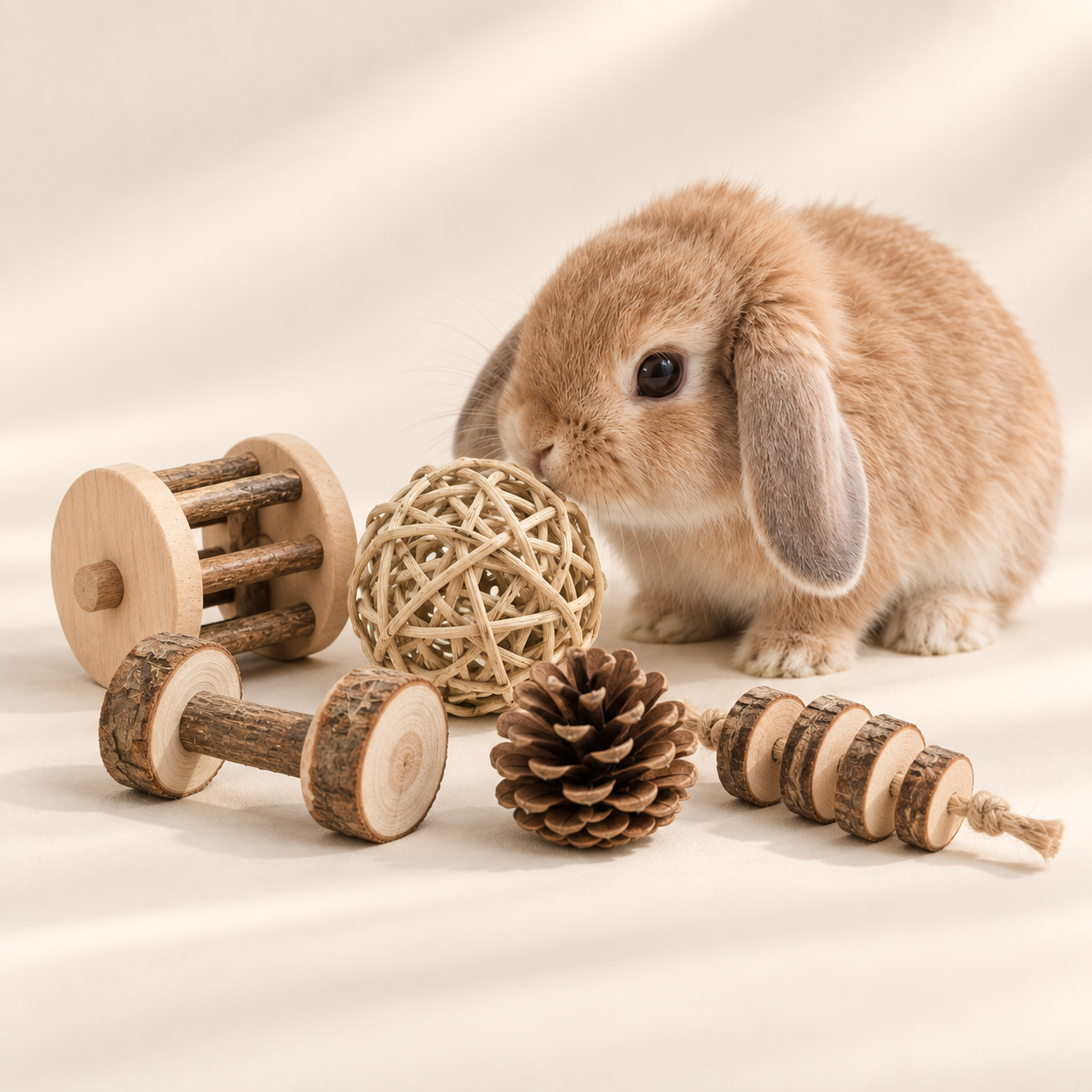
Play on your rabbit’s terms
Keeping a rabbit occupied does not mean asking them to perform a trick. They explore with their nose, paws and teeth and may choose to move an object rather than chew it. The ten ideas below suggest simple activities to adapt to size and preferences. None replaces sufficient space, available hay and suitable social relationships. Offer only a few objects at a time and watch how they are actually used. An ignored toy can be removed and presented differently later without pressure. Check safety before every session and during early introductions. Your companion does not need to enjoy every activity to benefit from a varied environment.
1. An apple wood stick
Appropriate untreated wood from a verified source can offer a sniffing and chewing activity. Apple wood is a common option, but a branch from a treated garden has different safety considerations from wood with a known origin. Place one stick on the floor and let your rabbit investigate. Remove pointed or damaged pieces and watch for problematic ingestion. Do not apply scent, varnish or household cleaning products to chewing wood. This activity does not treat dental disease: trouble eating or unusual drooling needs veterinary advice. Keep a normal hay supply available and remember that a rabbit may simply move the stick or ignore it.
2 and 3. Things to push and move
A suitable small wooden roller may be nudged with the nose, while a lightweight object can be moved between different parts of the play area. These two activities use different movements and help reveal your rabbit’s preferences. Check that every piece is too large to swallow and that no axle or join comes loose. Our five piece toy set allows rotation after inspecting each item. Leave a clear area around the objects so your companion can walk away. Never block the hideout entrance with a game. Introduce pieces individually rather than surrounding a hesitant rabbit with a complete new collection all at once.
4. A cardboard box to visit
A plain box can become an exploration space when it is clean, free from staples and accessible tape, and has no questionable coating. Cut openings wide enough for easy entry and exit. Check edges after a few sessions because chewing quickly changes the cardboard. Remove the box if your rabbit eats large amounts instead of mainly shredding it. Put it on a stable floor surface; a stack that can topple is not a safe obstacle course. Keep the usual retreat available so the new box remains optional. Do not place food so deep inside that your rabbit has to squeeze through an unsuitable opening.
5. A fresh hay discovery
A portion of fresh hay in a different location can be a very simple searching activity. Place it in a suitable open box without closing access or adding ties. Your rabbit must be able to eat immediately without solving a complicated mechanism. Use familiar hay and remove any that becomes soiled. This presentation supplements a permanent supply: it should never be the only way to obtain the main food. Avoid string, elastic bands and small accessories that might be swallowed. Watch whether your companion prefers digging, pulling a few strands or simply sitting nearby, and adapt the position rather than making the activity harder.
6. A comfortably wide tunnel
A suitable tunnel invites passing through, turning around or resting under cover. Its width must allow comfortable movement even when your rabbit moves quickly. Check stability, seams and any supporting frame; remove a tunnel if metal becomes exposed. If fabric is chewed or swallowed, choose a different material or another activity. Put the tunnel on a non slippery surface and keep both ends clear. Never shake it to make your rabbit come out. Allow them to choose their timing and avoid surprising a resting animal. A tunnel works best as an optional route rather than a compulsory passage between food and water.
7. A digging area
Some rabbits enjoy scratching in a low box with a suitable low dust material, such as plain paper pieces that you can monitor carefully. Start with a small amount and watch for ingestion. Avoid scented materials, small plastic pieces and substances of unknown composition. The container must stay stable and allow an easy exit. Digging can be messy, so choose a place you can clean without constantly interrupting the activity. Remove the setup if your rabbit shows no interest. They do not need to enjoy every game. Keep paper away from wet toilet areas and replace material that has become soiled or unsuitable for further play.
8. A ground level hideout
Hiding is also a way of interacting with the environment. An accessible house lets your rabbit choose between watching, resting and exploring. Check that they can turn around and leave easily, then respect the retreat. Our wooden hideout has two levels, but a rabbit with reduced mobility may need to remain on the ground. Inspect stability and surfaces before use and do not treat access to an upper floor as essential. Never pull your companion from a hideout to extend a play session. A reliable retreat supports calmer exploration around it precisely because it remains available whenever the rabbit chooses to take a break.
9. An easy food search
Scatter a small part of an already appropriate food ration on a clean surface or between several accessible dishes. Searching should remain easy and should not involve hunger or an increase in the daily ration. Do not introduce a new food and a difficult game together. For several rabbits, provide enough access points to reduce competition. Keep essential foods available independently of play. If your companion appears frustrated or gives up without eating, simplify the arrangement. Enjoyment comes from discovery and choice rather than increasing difficulty imposed at every session. Observe whether the activity is rewarding for the rabbit instead of judging only how interesting it looks to you.
10. A calm toy rotation
The tenth idea is not another object but a way to keep the others interesting. Store a few toys and alternate one or two while leaving the resting and feeding areas familiar. Clean, dry and inspect objects before offering them again. A simple note can record what your rabbit pushes, chews or ignores. Compare our apple wood sticks, wooden toy set and hideout using those observations. Buy for real use rather than to fill the living space. An open area with a few suitable activities is more useful than a collection that restricts movement. Keep preferred items available and change the optional toys at your companion’s pace.
Further reading: general guidance from Rabbit Welfare Association & Fund and House Rabbit Society. This guide does not replace individual advice from your rabbit veterinarian.
Rabbit Welfare Association & Fund · House Rabbit Society